Posts

how to use a digital multimeter
Image
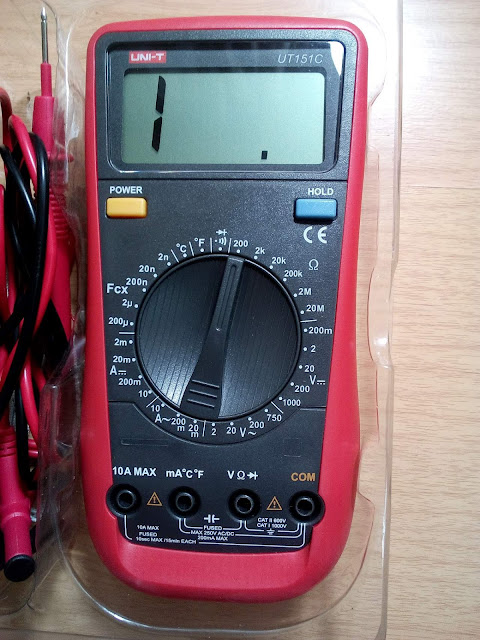
A multimeter is a tool that uses to measures electrical characteristic such as voltage, ampere, resistance. Using a multimeter and basic knowledge of ohm's law can help electronics projects much easier. There is two type of multimeter one is a digital multimeter and another is an analog multimeter. The advantage of digital multimeter is easy to read value, lower power consumption, and higher price model can measure diode, capacitance, frequency, duty cycle, inductance, the temperature you can call it all in one multimeter instead of a multimeter. How does a multimeter work? Basic functions of multimeter are measure voltage, ampere, and resistance. A multimeter changes electrical characteristic values to numbers for digital multimeter or meter scale for an analog multimeter. What type of multimeter you need: - If your project involves high dc current you must use high DC current type multimeter, the high current multimeter probe usually bigger and have separ...
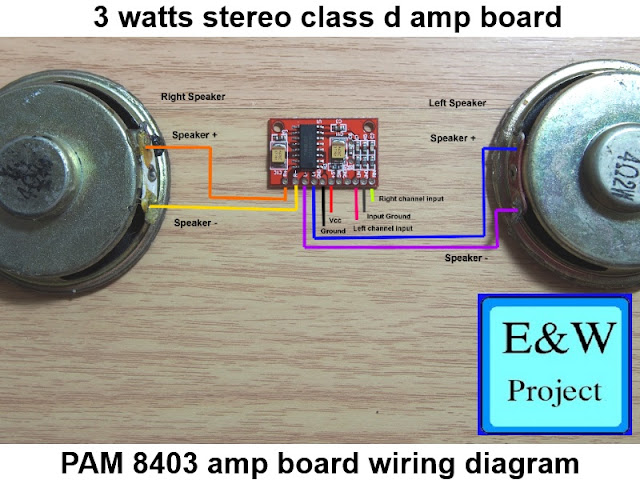
PAM 8403 board amp wiring diagram

Image
PAM 8403 is a portable 3 watts stereo class d amplifier that uses only 5 volts D.C. to operate. The amplifier board is easy to wiring and very small size, you can make a small amplifier project that not requires high voltages to work. The first thing you need to know. PAM 8403 cannot bridge together because the amplifier is already bridge-tie-load output configuration Over 6 volts can damage the amplifier module, if you want higher power you can check 10 watts class d amp PAM 8610 here You must use shield wire connect from input source to volume control and from volume control to the amplifier board input if you don't want your amplifier to suffer from parasitic oscillation (sound like JeeeeJeeee) Today I will show you how to wire PAM 8403 board amp that easy to understand. Let's see image below. You can see that two speakers do not share output ground like normal amplifier because PAM 8403 is a  bridge-tied-load amplifier, if each speaker wire touches eac...

How to add power supply filter capacitor to amplifier board.

Image
I saw a new comment on my video, he asked me how to add a filter capacitor to amplifier board D.C. power supply. I think it's a good question so I will explain it here. What is a power supply filter capacitor? It is the capacitor that used to filter AC ripple from DC power supply present to amplifier board. If an amplifier has low capacitive power supply capacitor, it may present a little hum(50/60 Hz low-frequency sound) that you can hear in a quiet room. The capacitor also stores power and bring it instantly to your amplifier when an amplifier needs more power for a short period of time such as  explosion sound in a movie. However, If an amplifier has high-frequency power supply noise from a switching power supply, small capacitor need to parallel to a power supply and must be attached close to power amplifier IC as much as possible. Below pictures are the place that you add power supply capacitor. PAM 8610 board amplifier powe...

How to connect volume control to an amplifier

Image
I saw a comment on my Youtube video, he asked me how to connect any amplifier module to a volume control or potentiometer. I think so many people who want to start an electronic project must know this basic wiring too, I hope this wiring diagram will help an electronic DIYer like me. First thing you need to know: use shield wire for an input signal to volume control and from volume control to amplifier if you don't want you amplifier suffers from parasitic oscillation (sound like JeeeeJeeeee). keep a wiring as short as possible. use low resistive value volume control (5-10 kilo-ohms) if the amplifier has random parasitic noise when you turn a volume control up or down. volume control is a potentiometer. Volume control principle is a signal divider, the more volume control output(yellow line) near input signal source(pink line) the most signal flow to an amplifier. When you lower a volume control the resistive va...

Hall effect sensor wiring diagram and test video

Image
Hall effect sensor switch is a switch that turns on when enough magnetic field near the IC. You can use hall effect sensor to make many Diy projects such as rpm meter, magnet detector, and more project involves with a magnet. Did you know? Hall effect sensor uses in many electric machines, example; when you open washing machine door and the machine stop spinning, or when you open microwave door then it pauses and send beeping sound until you close the door. Hall effect sensor IC in this post is A3144(old component but work well and low cost) Send output low (0 volts) when strong magnetic field near a sensor, that why somebody asked on the internet why his project involves hall effect sensor didn't work. Hall effect sensor wiring diagram. You can see an above image that a load(LED in this picture) connect to positive electrode and output instead output and ground. That's the reason why some projects don't work and will never work because the output low when magn...

0.9 volt to 5 volts boost converter test.

Image
I brought  0.9V-5V to 5V DC-DC Booster Module from eBay and I thought you should know the fact about this module before you buy it. The circuit module is very cheap (2 pcs for 1$ from eBay with free shipping) and very tiny to fit the small projects that require batteries if you not serious about Voltage swing with low voltages than 2.4 volts source. You can see the test video below. The advantage of this step up module: - high efficiency - incredibly low cost - small size Enjoy your project!!!

How to change broken illuminate switch.

Image
Outlet power strip is endurance but the illuminated switch seems fragile. The illuminated neon switch can't withstand high current load well and sometimes broken, but you don't have to buy new power strip because you can change just switch for very low cost. The video below will show you how to change on/off neon light rocker switch(illuminated switch) right way without making firework. Enjoy DIY world!!!

3 watts stereo amp board pam8403 sound test with jvc loudspeaker.

Image
PAM 8403 is a class d integrated amplifier that sounds good and energy efficiency. The ic requires only 5 volts for full 3 watts stereo (2 amperes 5 volts power supply need for full power) with 83 % efficiency @ 4 ohms load, so this amp board is good for battery power. This amp board sound good and fast respond but impact not good as pam8610 (high power version 10 watts stereo) but high frequency seem cleaner. Bass respond not tight(maybe my speakers are oversize) The amplifier board work well with 1-metre speaker cable so this amp is very stable and no need big power supply filter capacitor to eliminate hum from a power supply (Bass respond will be better if you add 2200 uf/16 volts electrolytic capacitor parallel to power supply filter. Make sure you connect electrolytic capacitor with correct polarity!!! or ka-boom.  PAM 8403 specification: - 3W Output at 10% THD with a 4Ω Load and 5V Power Supply - Filterless, Low Quiescent Current and Low EMI - Low THD+N - Sup...

15 watts stereo class T amplifier TA2024 sound test and review

Image
TA 2024 is low cost15 watts class T amplifier (I got it from eBay for 4.94$ free shipping). The amplifier board uses MKP film as input capacitor that hard to find in cheap board amplifier from eBay. The amplifier sound very clean and details and loud with high sensitivity loudspeaker (89 dB or better), bass not big but control well. However, high frequencies tend to roll off a little bit but still good. The TAta2024 amp is good with Jazz, pop, guitar solo, saxophone, and smooth jazz in my opinion. If you use switching power supply you need to add at least 2200 uf capacitor parallel to the power supply for best performance. TA 2024 specification: Class-T architecture  Single Supply Operation  “Audiophile” Quality Sound  0.04% THD+N @ 9W, 4Ω  0.18% IHF-IM @ 1W, 4Ω  11W @ 4Ω, 0.1% THD+N  6W @ 8Ω, 0.1% THD+N  15W @ 4Ω, 10% THD+N  10W @ 8Ω, 10% THD+N  High Efficiency  81% @ 15W, 4Ω  88% @ 10W, 8Ω  D...

10 watts 8 ohms class d amplifier pam8610 sound test

Image
Pam8610 IC is 10 watts @ 8 ohms (15 watts @ 4 ohms small heat sink require) stereo class d amplifier with very high efficiency over 90% and the amplifier works well without any heat sink at full power!!! . The amplifier board is very low cost ( around 1 $) but deliver 10 watts @ 8 ohms power from 13 volts power supply. As you can see in my video that the amp board require only one 100 uf electrolytic capacitor for supply decoupling to eliminate hum from switching power supply(some ic amplifier require 1000 uf to eliminate hum from the power supply). Sound testing: The amplifier sound good with good bass respond  good bass impact and well control (kick bass very good). High frequency clean, impact well and flat but lack transparent. Singer vocal is clean but not transparent. The sound stage is wide but space between instrument not precise. pam 8610 amp board is the quiet amp with very less hiss noise (5 cm away from tweeter to my ear :) which is not a big problem at all and ...

Low frequency bass test sine wave

Image
Let's test your subwoofer low-frequency respond. Each frequency duration is 3 second long so you can here different clearly. Frequencies start from 1Hz to 300Hz. You may not hear 1 -10 Hz sine wave frequencies because human hearing limitation but modern amplifier can amplify this low-frequency band, sometimes if you play these low-frequencies loud enough your body can feel it. You also can not hear 11 - 19 Hz (some golden ears human may hear 18 - 19 Hz) but your room will be shaking if you play these frequencies band loud enough. 20 - 30 Hz frequencies range are audible if you have a big speaker, good headphone or subwoofer, a small speaker may not produce these low frequencies or sound decrease so much but you can feel it when you touch the speaker. A good desktop external speaker low-frequency cut-off around 80 - 100 Hz but a normal laptop built-in loudspeakers low-frequency cut-off around 150 Hz. Below video will come in handy when you work out side but for...

Modified lepy LP-A6fm amp

Image
When I brought lepy LP-A6fm from my local store(Thailand) for under 10 $.  I though it's a good low-cost amp and I've found that this amp not bad at all. The bad thing I hate LP-A6fm is the amp have big pop noise when connecting to the power supply to the amplifier and the amplifier doesn't have any on/off switch. I thought the problem may come from JRC 4558 op-amp that doesn't have soft on/off function so I decided to change JRC 4558 to ne5532 op amp for low pop noise and change some capacitors for sound quality improvement. Yeah! Let's start. List of component: 1 x ne5532 opamp and 8 pins ic socket (for JRC 4558 op amp replacement, sound improve much). 3 x capacitor 100 uf muse FW(FG are better) for op amp power supply replacement and for main amp replacement 4 x 10 uf Elna Ccerafine or Silmic II electrolytic capacitors for the mellower sound. 1 mks 0.1 uf Wima capacitor(not see in the video because it attaches to preamp power supply under PCB board. 2 x...